Cost of Equity Modigliani Miller: How Debt Raises the Rate
Cost of equity Modigliani Miller: the levered firm formula, why debt raises the rate, and a worked example at three debt levels from an 11% base.
By the CostOfEquityCalculator.com team
Cost of equity under Modigliani Miller rises with debt in a straight line, and Proposition II is the equation that does it: Ke = Ku + (Ku - Kd) x D/E. The cost of equity of a levered firm equals the all-equity rate plus a spread that grows with the debt-to-equity ratio.

Add corporate tax and that spread shrinks by a factor of (1 - t), but it still climbs. A higher number does not mean the borrowing was a bad idea. The same model that pushes the cost of equity up can hold the weighted average cost of capital flat or pull it down.
Why shareholders demand more when debt rises
Interest is paid before dividends. Lenders hold a fixed claim on the first slice of operating profit, so whatever is left for shareholders moves more than operating profit does.

Take two companies with identical assets and identical operating profit. One is funded with equity alone. The other borrows half its capital. If operating profit falls 10%, equity holders in the borrowing company lose a larger share of their claim, because the interest bill does not fall with it.
That extra swing is financial risk, and it sits on top of the business risk both companies already carry. The short answer on whether cost of equity increases with debt covers the direction. This page gives the formula.
The asset risk itself has not changed. Modigliani and Miller showed that it gets redistributed, not created. Debt holders take a safe slice, and everything they did not absorb lands on a smaller pile of equity.
The levered cost of equity equation
Without corporate tax:
Ke = Ku + (Ku - Kd) x D/EWith corporate tax:
Ke = Ku + (Ku - Kd) x (D/E) x (1 - t)Ke is the levered cost of equity. Ku is the unlevered cost of equity, the rate an all-equity version of the same business would face. Kd is the cost of debt, t is the corporate tax rate, and D/E is debt over equity at market values.
The Modigliani-Miller theorem comes in two parts. Proposition I says capital structure does not change firm value when there are no taxes. Proposition II is the consequence: if total value is fixed, the cost of equity has to rise by exactly enough to keep the blended rate constant.
Tax changes the first proposition. Interest is deductible, so borrowing creates a tax shield and the levered firm is worth more than the unlevered one. The (1 - t) term shows what the shield does to the cost of equity line. It still slopes up, just less steeply.
Working an example at three debt levels
Start from the standard example on this site. A 5% risk-free rate, a beta of 1.2 and a 5% equity risk premium give an 11% cost of equity through the CAPM calculation. Treat that 11% as the unlevered rate, Ku.
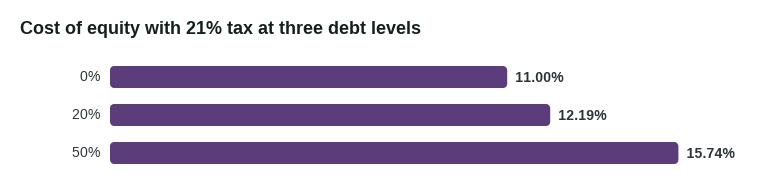
Assume debt costs 5%, the same as the risk-free rate. That is the simplifying assumption built into the basic form, and it matters further down. The tax rate is 21%.
| Debt share of capital | D/E | Ke, no tax | Ke, 21% tax | WACC, 21% tax |
|---|---|---|---|---|
| 0% | 0.00 | 11.00% | 11.00% | 11.00% |
| 20% | 0.25 | 12.50% | 12.19% | 10.54% |
| 50% | 1.00 | 17.00% | 15.74% | 9.85% |
The middle row, with tax: 11% + (11% - 5%) x 0.25 x 0.79 = 11% + 1.19% = 12.19%.
The bottom row: 11% + 6% x 1.00 x 0.79 = 15.74%. At half debt, shareholders want nearly five points more than they wanted with no debt at all.
Why WACC can fall while cost of equity climbs
Run the no-tax column through a weighted average and nothing moves. At a 50% debt share: 0.5 x 17% + 0.5 x 5% = 11%. At 20%: 0.8 x 12.50% + 0.2 x 5% = 11%. That is Proposition I in arithmetic.
Tax breaks the tie. The after-tax cost of debt is 5% x 0.79 = 3.95%, so the blend gets cheaper: 0.5 x 15.74% + 0.5 x 3.95% = 9.85%.
There is a shortcut for the tax case. WACC = Ku x (1 - t x D/V), where D/V is the debt share of capital. At 50% debt: 11% x (1 - 0.21 x 0.5) = 9.85%.
A rising cost of equity and a falling cost of capital are the same event seen from two different seats. The guide on cost of equity versus WACC works through why the two rates get used for different jobs.
Proposition II and relevering a beta are the same idea
Hamada’s equation relevers a beta instead of a rate:
Levered beta = Unlevered beta x (1 + (1 - t) x D/E)At a D/E of 0.25: 1.2 x (1 + 0.79 x 0.25) = 1.44. Put that through CAPM and you get 5% + 1.44 x 5% = 12.19%, the same figure as the table. Hamada’s equation is Proposition II rewritten in beta terms, which is why the two answers match when debt is priced at the risk-free rate.
This matters when you pull a beta from somewhere else. Published betas are levered, so they already carry the debt of the companies they came from. Strip that out to an unlevered beta, then relever at the ratio you are testing. The guide on levered and unlevered beta has the steps in order. The industry cost of equity table is built from levered betas, so a heavy-borrowing sector already shows the effect.
Where the model stops being realistic
Debt is not risk free. Past a moderate ratio lenders charge more, Kd rises toward Ke, and the spread that drives the whole formula narrows. The straight line flattens and then bends.
There are no bankruptcy costs in the model. Real firms facing distress lose customers, sell assets in a hurry and pay lawyers, and none of that appears in the equation.
The tax shield needs taxable profit. A company with losses carried forward gets no deduction this year, so the 21% version overstates the benefit.
Use market values for D and E. Book equity understates the base for most profitable companies, which inflates D/E and the rate along with it.
Debt is also not the only input that moves the number. The list of other things that raise cost of equity covers the rest.
Try it at your own debt level
The Cost of Equity Calculator on the home page takes a risk-free rate, a beta and an equity risk premium. Enter the unlevered inputs first to fix Ku, then relever the beta at the D/E you are considering and run it again. The gap between the two answers is the financial risk charge in this guide.
Frequently asked questions
What is the cost of equity formula for a levered firm?
Ke = Ku + (Ku - Kd) x D/E without tax, and Ke = Ku + (Ku - Kd) x (D/E) x (1 - t) with corporate tax. Ku is the all-equity cost of equity, Kd is the cost of debt, and D/E uses market values. Starting from an 11% unlevered rate, 5% debt and a 21% tax rate, a D/E of 1.0 gives 15.74%.
Why does cost of equity increase as debt increases?
Interest is paid before dividends, so a fixed interest bill makes the profit left for shareholders swing harder when revenue moves. The underlying business risk has not changed. It is concentrated on a smaller equity base, so shareholders ask for more. Modigliani and Miller price that extra swing as (Ku - Kd) multiplied by the debt-to-equity ratio.
Does a higher cost of equity mean the borrowing was a mistake?
Not by itself. Without tax, the cost of equity rises by exactly enough to hold WACC flat, so firm value does not move. With a 21% tax rate and deductible interest, WACC falls while the cost of equity climbs: 11% down to 9.85% at a 50% debt share in the example. Distress costs eventually reverse that.
Should D/E use book values or market values?
Market values. The formula compares required returns set in markets, so the weights have to be market weights. Book equity records past contributions and retained profit, and for a profitable company it usually understates the equity base. That inflates D/E and overstates the levered cost of equity. Use share price times share count for equity.