Cost of Equity and Cost of Retained Earnings: Which to Use
Cost of equity and cost of retained earnings compared: why new shares cost more once issue costs are counted, with an 8.16% and 8.38% worked example.
By the CostOfEquityCalculator.com team
The cost of equity and the cost of retained earnings are usually the same number: both measure the return shareholders require, and retained profit already belongs to those shareholders. The cost of external equity, meaning cash raised by issuing new shares, sits a little higher, because an issue has to pay for itself before the project sees a dollar.
That gap is small, and it is the only reason analysts split the two apart. If you are still picking a formula, start with the overview of the four cost of equity methods, then come back here for the retained earnings question.
Why retained earnings are not free money
Retained earnings are the profits a company kept instead of paying out. They show up inside the equity section of the balance sheet as a running total of past decisions.
The money belongs to the shareholders. Every dollar held back is a dollar they did not receive, and they accept that only if the company can earn at least what they could have earned elsewhere at the same risk.
So the cost of retained earnings is an opportunity cost, not an invoice. Nothing is deducted in the accounts, which is why people assume the funding is free.
It is not. The short answer on whether you can find cost of equity on the balance sheet explains why the figure never appears in the statements at all.
One more point worth remembering: equity gets no tax deduction. Interest on debt is deductible, so a 21% tax rate cuts the effective cost of borrowing. Dividends and retained profit are paid out of after-tax income, so a 21% rate does nothing to the cost of equity.
The cost of retained earnings
Use the ordinary cost of equity formula. Nothing is added and nothing is taken away.
Under CAPM, with a 5% risk-free rate, a beta of 1.2 and a 5% equity risk premium, the cost of equity is 5% + 1.2 x 5% = 11%. The walkthrough on how to calculate cost of equity using CAPM covers where each input comes from.
The dividend discount model gives a second route. A $50.00 share that just paid $2.00 with 4% expected growth has a next dividend of $2.08, a yield of 4.16%, and a cost of equity of 4.16% + 4% = 8.16%. The guide on the dividend growth model runs through that arithmetic in full.
Both figures are the cost of retained earnings. Textbooks often write the retained earnings version as Ks and the external version as Ke, though the notation is not consistent across books. The note on why cost of equity is written as Ke covers the symbols you will meet.
What issuing new shares adds to the cost
When a company sells new shares, part of the money raised never arrives. Underwriters take a fee. Lawyers, auditors, registrars and printers all bill. Those are issue costs, also called flotation costs.


The new shareholders do not care about any of that. They paid $50.00 and they want their required return on $50.00. The company, meanwhile, has less than $50.00 per share to invest.
The cost of external equity formula
Ke = D1 / (P0 x (1 - F)) + gF is issue costs as a share of the offer price. Everything else matches the dividend growth model.
Take the same stock and assume issue costs of 5% of the offer price. Net proceeds are $50.00 x 0.95 = $47.50. Then $2.08 / $47.50 = 4.38%, and 4.38% + 4% = 8.38%.
So the cost of external equity is 8.38% against 8.16% for retained earnings. The difference is 22 basis points. Issue costs themselves vary a lot by deal size and market conditions, with small offerings generally costing a larger percentage than big ones, so treat the 5% as an illustration and use quoted figures from the actual deal when you have them.
Issue costs in the formula, or in the project cost
CAPM has no slot for issue costs. It prices risk, not transaction expenses, so it returns 11% whether the cash came from retained profit or a new offering.
That leaves two defensible treatments.
- Shrink the proceeds and raise the discount rate, as the 8.38% example does.
- Keep the discount rate at the retained earnings figure and subtract the cash spent on the issue from the project’s net present value.
Many finance texts prefer the second. Issue costs are paid once, at the start, while a higher discount rate penalises every year of future cash flow. The one rule that matters either way is to count them once.
Which figure belongs in a project decision
Most capital budgeting runs on the cost of retained earnings. Companies fund the large majority of investment from internal cash and debt, so the equity leg of the hurdle rate should be the retained earnings number, 11% in the example above.
Reach for the cost of external equity only when the project actually forces a share issue. That happens when internal cash and sensible borrowing run out, which is the point where the marginal dollar of equity genuinely carries fees.
Do not raise a hurdle rate because the company sold shares three years ago. Those costs are sunk, and the money in the bank today has no fee attached to it.
Private companies face a wider gap. A build-up calculation might put the cost of equity at 15%, and raising outside equity privately brings broker fees, diligence costs and legal work on top, often a larger percentage of a smaller raise.
A side by side example
Same company, same share price, same growth rate.
| Source of equity | Formula | Site example | Result |
|---|---|---|---|
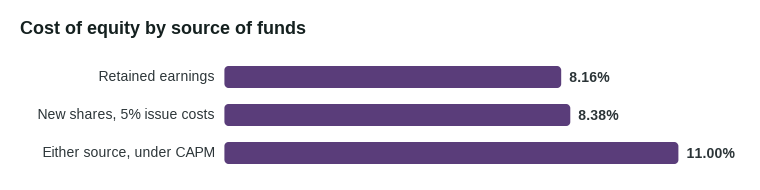
| Retained earnings | D1 / P0 + g | $2.08 / $50.00 + 4% | 8.16% |
| New shares, 5% issue costs | D1 / (P0 x (1 - F)) + g | $2.08 / $47.50 + 4% | 8.38% |
| Either source, under CAPM | Rf + beta x ERP | 5% + 1.2 x 5% | 11.00% |
The lesson from the table is that issue costs change the answer by a fraction of a percentage point, while the choice of method changes it by nearly three. Pick and defend your method first. Then worry about the issue costs.
Run both figures
The free cost of equity calculator on the home page has tabs for CAPM, the dividend discount model and the build-up method. Enter the $50.00 price for the retained earnings figure, then enter $47.50 as the price to see the cost of external equity for the same stock.
Frequently asked questions
Is the cost of retained earnings the same as the cost of equity?
For practical purposes, yes. Retained earnings belong to shareholders, so keeping them has an opportunity cost equal to the return those shareholders require. In the site example that is 11% under CAPM, or 8.16% under the dividend growth model. The only figure that differs is the cost of external equity, which adds the expense of issuing new shares.
What is the cost of external equity formula?
Take the dividend growth model and shrink the proceeds. Ke = D1 divided by net proceeds per share, plus the growth rate. With D1 of $2.08, a $50.00 share, 4% growth and issue costs of 5%, net proceeds are $47.50. That gives 4.38% plus 4%, so 8.38% against 8.16% for retained earnings.
Why does new equity cost more than retained earnings?
Because part of the money raised never reaches the company. Underwriting fees, legal and accounting work, listing costs and printing all come out of the gross amount. The new shareholders still expect their full required return on the price they paid, so the company has to earn that return on a smaller sum of cash.
Should issue costs go in the discount rate or the project cost?
Either works if you only count them once. Many textbooks prefer treating issue costs as a cash outflow in the project's upfront cost, because they are paid once and do not change the risk shareholders bear forever. Raising the discount rate instead spreads a one-time expense across every future year of cash flow.