Equity Risk Premium vs Market Risk Premium: Are They the Same?
Equity risk premium vs market risk premium: usually the same number, with two real differences. See which risk-free rate and market proxy each one assumes.
By the CostOfEquityCalculator.com team
Equity risk premium vs market risk premium is mostly a naming difference: both terms mean the extra return investors expect from the stock market over a risk-free government bond. In standard CAPM work you are looking at the same input twice, and this site’s calculator has one field for it. The names only come apart when someone gets precise about which risk-free asset is subtracted and which market is being measured.
What the equity risk premium measures
The equity risk premium is the extra annual return expected from owning stocks instead of holding government bonds. It pays you for taking market risk that no amount of diversification removes.
You cannot look it up the way you look up a bond yield. The number sits in the expectations of millions of investors, so every published figure is an estimate with a method behind it. The guide on published premium estimates and how they are built covers the two figures most analysts quote and why they rarely agree.
Published US estimates have mostly sat in the 4% to 6% range in recent years. The figure depends on the market and moves as prices move, so read the source on the day you build the model.
What the market risk premium measures
Market risk premium means the expected return on the market portfolio minus the risk-free rate. Written out it is E(Rm) - Rf, the middle piece of the CAPM formula.
That is the same quantity seen from the model’s side rather than the investor’s side. “Equity” names the asset class. “Market” names the portfolio in the equation.
Why most textbooks treat them as the same number
CAPM needs a market portfolio, and every working version of it uses a broad stock index. Once the market is a stock index, the market risk premium is an equity premium by construction.
So data providers publish one number and let you label it either way. Your model has one place to put it. Treating the two as separate inputs is the real mistake, because it tempts you to add a premium twice.
| Equity risk premium | Market risk premium | |
|---|---|---|
| Plain definition | stock returns above risk-free returns | E(Rm) - Rf |
| What stands in for the market | a broad stock index | the model’s market portfolio |
| Value you would type in | the same number | the same number |
| Where the name shows up | data providers, the build-up method | CAPM, the security market line |
Where the two really differ
The risk-free asset you subtract
Both premiums are a difference, so the answer depends on what gets subtracted. A premium measured against the 10-year Treasury yield is not the same as one measured against a 20-year yield or a normalized rate.
Keep the pair together. Use the risk-free rate the premium was built against, and take spot yields from the Treasury’s daily par yield curve when you need them. Dropping a high premium onto an unrelated low rate quietly changes the return you are assuming for the whole market.
The market proxy you measure
In theory the market portfolio in CAPM holds every risky asset, including bonds, property and private businesses. Nobody can measure that, so an index stands in for it.
This is the one case where a purist would split the terms. A true market risk premium would cover all risky assets, while an equity risk premium covers stocks only. Since the proxy is a stock index either way, the distinction stays theoretical in day to day valuation work.
Is the equity risk premium the same as the market return?
No. The premium is a difference, and the market return is the whole thing. With a 5% risk-free rate and a 5% equity risk premium, the expected market return is 10%.
The same trap runs in reverse. If a source hands you a 10% expected market return, the premium is 5%, once you subtract the risk-free rate that source used.
Market risk premium vs expected return on a stock
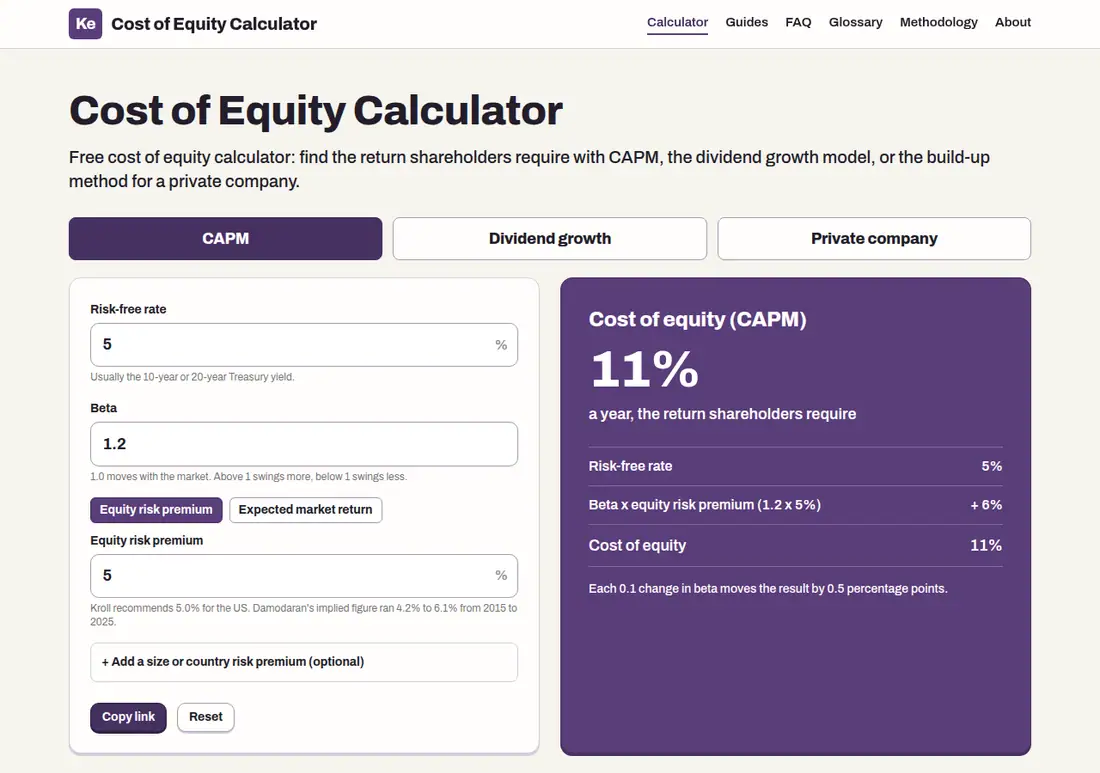
The premium prices average market risk. A single stock gets scaled by its beta. Run the site example through the CAPM cost of equity steps and you get 5% + 1.2 x 5% = 11%. So the market risk premium is 5%, the expected market return is 10%, and the expected return on this stock is 11% because its beta is 1.2.
Country risk and size premiums are add-ons, not part of either
Published US premiums are mature market numbers. They hold nothing for operating in a riskier country, for being small, or for one customer making up half of sales.
The country risk premium is a separate layer added on top. That settles the equity risk premium vs country risk premium question: one covers stock market risk in general, the other covers one country’s extra risk. The short answer on adding a country premium to cost of equity shows where it goes in the formula, and the guide on cost of equity by country handles the currency side too.
Size premiums work the same way. In the build-up method each one sits on its own line, which is how that method reaches a 15% cost of equity for a small private company: a 5% risk-free rate, a 5% equity risk premium, a 3% size premium, no industry adjustment and a 2% company-specific premium. Naming the layers is what stops double counting.
Which term to use when you write up a cost of equity calculation
Pick one name and say what is behind it. “Equity risk premium of 5.0%, used with a 5% risk-free rate, from source X” tells a reviewer everything the bare label does not.

Use market risk premium when you are writing the formula and want the reader to see E(Rm) - Rf. Use equity risk premium when you are listing inputs or stacking build-up layers. Do not put both names in the same input table.
There is also the option of skipping the premium. The dividend growth model needs no premium at all. A $50.00 share that just paid $2.00 with 4% growth gives D1 of $2.08, a 4.16% dividend yield and an 8.16% cost of equity.
Try it with your own numbers
Open the cost of equity calculator on the home page, enter a 5% risk-free rate, a beta of 1.2 and a 5% premium, and it returns 11%. There is one premium field. If your data source calls that number the market risk premium, that is still the field it belongs in.
Frequently asked questions
Is the equity risk premium the same as the market risk premium?
In normal practice, yes. Both names mean the extra return investors expect from stocks over a risk-free government bond, and CAPM has one slot for it. The only real difference is theoretical: a true market premium would cover every risky asset, while an equity premium covers stocks. Since the market proxy is always a stock index, the numbers match.
Is the equity risk premium the same as the market return?
No. The premium is a difference, not a total. With a 5% risk-free rate and a 5% equity risk premium, the expected market return is 10%. Going the other way, a source quoting a 10% expected market return implies a 5% premium once you subtract the risk-free rate that source used.
Is the country risk premium part of the equity risk premium?
No. Published US premiums are mature market figures and hold nothing for a riskier country. The country risk premium is a separate layer added on top of the risk-free rate and the equity risk premium. Keeping it on its own line is what stops you from counting the same risk twice in one cost of equity.
Which name should I use in a valuation write-up?
Use market risk premium when you are writing the CAPM formula and want the reader to see expected market return minus the risk-free rate. Use equity risk premium when you are listing model inputs or stacking build-up layers. Either way, state the source and the risk-free rate it was measured against, and never list both names in one input table.